CVIRL · Re-anchor test
Re-anchoring the reference every cardiac cycle: does it help?
Shubh's second idea: instead of tracking the whole clip from one reference frame, reset the reference to end-diastole at the start of every heartbeat, so drift can only build up for ~25 frames before it snaps back to a clean frame. Tested it on the same murine series. Honest result below.
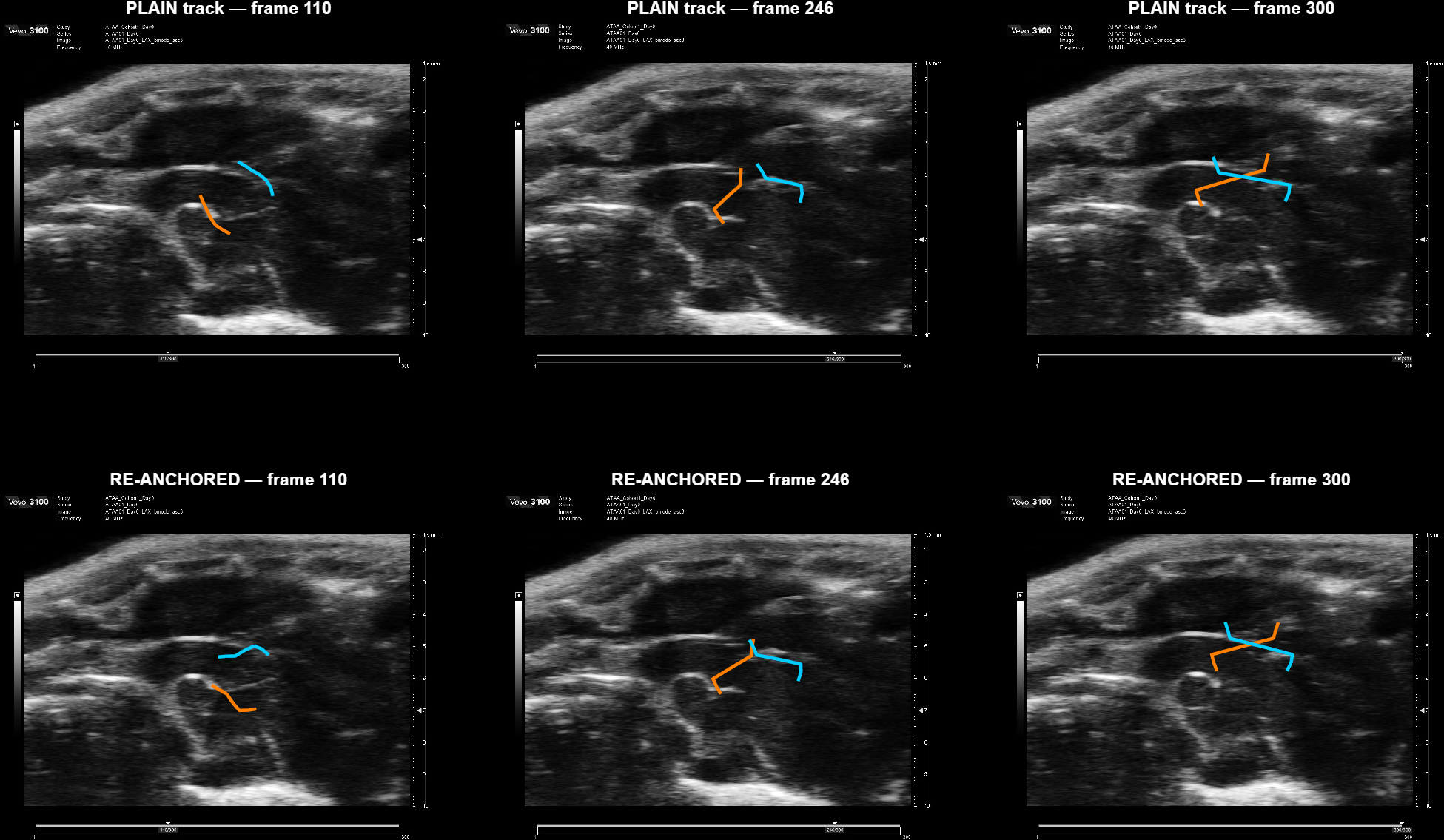
Bottom line. It did not help. Re-anchoring every cycle produced a track essentially identical to the plain single-reference track — same drift, and the same catastrophic collapse in the back third of the clip where the two walls cross into a tangle. A reference reset is only as good as the reference, and the only anchors available come from a first track that has already drifted, so re-anchoring just reproduces the drift instead of correcting it.
Plain track vs re-anchored, side by side
Top row is the plain single-reference track; bottom row is re-anchored every cycle. Same three frames. They are the same.
The re-anchored track over the whole clip (the [RE-ANCHOR] tag marks each cycle reset):
An important side finding
The first track used as the source of anchors is the saved "good timing example." It also collapses in the last third — the plain-track top row above is that example, and it tangles at frames 246 and 300 just like the re-anchored version. So the back third of even that reference track is not trustworthy. Any measurement taken from those late frames inherits the collapse.
The honest read
Two separate ideas have now been tested and both failed for the same underlying reason: image preprocessing (clean up the picture) and re-anchoring (reset the reference each cycle). Neither is an image problem or a reference problem. The parametric tracker seeds each frame from the last and lets its match-template wander, so it drifts, and on this low-contrast data it eventually walks the wall shape into a degenerate crossing. Reference tricks and image tricks can't fix a tracker that collapses.
The path that actually removes this failure is per-frame wall detection (segmentation): find each wall independently on every frame, with nothing carried forward to drift or collapse. That is a different kind of tool than the current tracker, and it is where the effort should go next.